Custom Search
Showing posts with label indonesia. Show all posts

by : Daniswara Pandina (PT. Telkomsel Indonesia)

Start in 2008, costly network will not longer be the first issue as Telkomsel, introduced its innovative rural solution by using IP Pico BTS over VSAT IP Transmission- It’s opportunity for Industry!!

Telkomsel is the biggest GSM Operator in Indonesia with mobile subs 58 million in urban and Suburban. 13.000 site will be deployed till the end of 2008, including in outer islands and Indonesian border.

The solution gives deployment advantages for rural connectivity, It will open new possibilities for industry to reevaluate rural market by providing expandable GSM hotspot.

Network Configuration

Network Info

Deployment Advantages

Access

Pico Cell/ BTS GSM, 1TRX

Min SITAC,

No Tower

Fast Install,

Low Power,

Low Capex,

Low Opex,

No Dependencies on Geography, Low cost transmission backhaul, Hotspot Coverage approach

Access

Controller

IP BSC connected to MSC

Telkomsel and IP VSAT

satellite system

Transmission

VSAT IP

Power

Gov. Elcty/Battery back up

charged & discharged by Solar Cell System.


In July 2008, Telkomsel announce its program to provide rural connectivity with project called “Telkomsel Merah Putih”. The programs run to be complementary to USO (Universal Service Obligation). Program held by government : Up to 13.000. sites will be deployed by the solution until the end of 2009.

The solution technology is PICO GSM IP BTS platform over VSAT IP transmission. All solution powered by Solar Cell where government electricity does not exist; Voice & data over 2G ; The program is Key initiative to help the nation and solve first issue in providing connectivity in rural Area as well as to penetrate new market.

ICT industry in Indonesia is now ready to engage the nation’s connectivity by low cost and effective solution. rural connectivity is never ending process.

Raise the potential undeveloped local community at of community, and the same time create new business. By cooperation between industry, government and local community can create value for all and inspire private sector to participate participate.

It is proven that rural market could be profitable with the right approach, although difficulties and challenges in developing economies still have to be overcome.

Source :
http://www.mtc.gob.pe/portal/apectel38/lsg_industry/08_tel38_lsg_ir_003_industry-telkomsel_DaniswaraPandina%20%5BCompatibility%20Mode%5D.pdf

Read More......

PT. Transnetwork Communication Asia (“TCA”) was esthablish in 2005, by a group of professionals in advanced data communication solution through Satellite, Fiber Optic, Radio Link Network and Internet services. The Company has a wide range of services in Fiber Optic, VSAT connections, Internet services, and information technology.

Lead by a team of experienced and entrepreneurial managers who are dedicated and committed to bring the Company and business model to success in information technology and telecommunication businesses.

TCA provides a full international class customer-related solutions in Indonesia and regionally covering among others:Internet Services, Broadband VSAT Services, Wireline and Wireless Network, Information Technology


PT Telkomsel announced six network vendors to provide 6000 VSAT-IP Satellites for the Universal Service Obligation (USO) project will implemented in the 24.056 villages, and TCA provide 1000 VSAT for four months until September 2009.

PT. Transnetwork Communication Asia have License from Minister of KOMINFO for: Network Access Provider (NAP) No 1575/PT.003/DITTEL/SRT/2006; Jaringan Tetap Tertutup (JARTUP). No 2017/PT.003/DITTEL/SRT/2007 ; Landing Right / Hak Labuh Satelit. No. 036/DPJT.1/HLS/08/2007 for SATELLITE; AsiaSat4, AMC-23 / GE 23 , Apstar 5, Panamsat 4.

And Partnership Agreement with: PCCW Global Pte.Ltd; SpeedCast Ltd HK (subsidiary of Asiasat HK); Kabel Vision/Lippo Group (Fiber Optic Connection); TELKOM; ICON+; Excelcomindo; Lintasarta

For more information, visit http://www.tca.net.id

Read More......

Anita Rachman, JG, The country’s space agency successfully launched an unmanned rocket on Thursday, one small step in a plan to get a satellite into orbit by 2014, one of its executives said.

Toto Marnanto Kadri, the head of the Aerospace Electronics Technology Center at the Indonesian National Institute of Aeronautics and Space (Lapan), said the RX-420 rocket successfully blasted off into space on Thursday at around 8 a.m. from a launch pad in Pameungpeuk, several kilometers from the town of Garut, West Java.

“This is an experimental rocket. We launched it to measure our work and record information such as rocket trajectory data, height, launch position and so on,” Toto said. “This is part of our efforts to develop rocketry.”

He said data from the launch would be particularly valuable for the agency’s efforts to build its first satellite-deploying rocket, which is scheduled for liftoff in six years.

In a statement on the agency’s Web site, Lapan Chief Adi Sadewo Salatun said the launch had gone well. He stated that Lapan had managed to gather all of the key data from the launch’s first 10 seconds, information referred to as the “golden data.”

Toto said the rocket, with a diameter of 42 centimeters at its widest point, is the thickest rocket launched in the country so far. He said it fell to Earth after just a few minutes after blasting off, when its fuel ran out at a peak height of about 50 kilometers.

The 6.2-meter rocket carried a GPS device, an accelerometer and a temperature sensor.

He said that the launch was also a key advance for other components of the agency’s research program, such as a plan to send its first satellites into orbit in 2010. That project would carry remote-sensing surveillance and amateur radio communication equipment.

Lapan carried out a stationary test on RX-420 on Dec. 23 in Tarogong, West Java. Last year, the agency launched two smaller 32-cm diameter RX-320 rockets, also from the base in Pameungpeuk. The Lapan A-2 and Lapan-Orari satellites are to piggyback into orbit on an Indian rocket slated for launch in April. Lapan expects to finish those satellites by February.
source : http://thejakartaglobe.com/national/space-agency-launches-rx-420-rocket/315934

Read More......

In January 2009, the Indonesia Information and Communications ministry announced PT Telkomsel as the winner of five of the project's seven tender packages that aim to ensure basic fixed lines and that all affordable wireless services for citizens across the country. The packages also offer specialized tariff schemes for low-income people with fixed network connections, Internet access and public call boxes.

Three state universities signed an MoU with PT Telkomsel on Friday (05/08/2009) to research the impact of telecommunication services in rural areas.

The Universal Service Obligation (USO), will affect the cultural, economical, social and political conditions of the people living in the areas, the Indonesian government is targeting to connect 38,000 remote villages by 2010.

The research will provide information on market-mapping, operational constraints, social segmentation and communication behavior among villagers, also serve as a means for the government to monitor the progress of the project and its impact on the societies, and to better understand the social expectation on the project.

And PT Telkomsel announced six network vendors to provide 6000 VSAT-IP Satellites for the universal service obligation (USO) project will implemented in the 24.056 villages.

The vendors is AJN Solusindo, Tangara Mitrakom, Patrakom, Telkom Divisi Enterprise, Konsorsium Aprotech, and Transnetwork Asia, each vendors provide 1000 VSAT for four months until September 2009.

Read More......

About Digital Network Knowledge (DNK)
DNK is a brand image and a trade mark of PT. Dini Nusa Kusuma, as a company that provides ICT - Information Technology Communication, DNK has proper certifications and be the first who obtain BGAN Inmarsat certification in Indonesia. DNK has proper licenses incompliance with the Indonesia telecommunication regulation.
  • DNK Digital Network Knowledge, a reliable service operator of BGAN-INMARSAT and the first company with authorized certification data's - Internet categorize in Indonesia.
  • BGAN refers to be a best solution of VSAT and offers a newer feature of IP technology satellite belongs to International Maritime Satellite (INMARSAT).
  • BGAN performs new technologies and has taken over RBGAN services which the closure of the RBGAN service will be withdrawn on 31 December 2008.
  • Beam covers up across most of the global Earth's surface but apart for North and South poles.
  • BGAN is the most advanced and affordable broadband services in highly compact and most cost effective usages.
For more information please visit http://www.dnk.net.id/

Read More......

By Prima Setiyanto Widodo
Satellite Communications Systems are infrastructures that can be used for broadband multimedia applications. In the communication satellite field, the C-band (4-6 GHz) frequencies have been used since the beginning and are now saturated. The Ku-band (11-18 GHz) has been used also for communication satellite systems, because with this frequency a bigger bandwidth can be applied. The Ku-band has other advantages, such as avoidance of interference with terrestrial microwave systems that often use the C-band frequency. However, for Indonesia, the use of the Ku-band needs a thorough examination because frequencies above 10 GHz are vulnerable to rain, especially heavy rain that often occurs in Indonesia. This article examines the possibility of using the Ku-band for satellite communication systems in Indonesia.

In 1976 President Soeharto of the Republic of Indonesia, gave the name PALAPA to the first Indonesian satellite. At that time Indonesia was the 3rd nation in the world to use satellites as its telecommunications infrastructure. Indonesia can be proud of this fact, because Indonesia’s neighbors Singapore, Malaysia, the Philippines and Thailand had not yet shown any interest in having their own satellites.
Indeed, considering Indonesia’s geographical features: consisting of islands stretching from West to East and from South to North, it is reasonable for Indonesia to adopt a satellite platform for its communications system. By using satellites one can obtain wide coverage, quick rollout of facilities (compared to buried optic fiber cables) unconstrained by natural conditions and distance.
Indonesia is now not alone in South-east Asia/East Asia in utilizing satellite services for voice, video and data. Twenty years after the historic launch of its first satellite in 1976, Malaysia and Thailand have launched their own satellites, followed by Singapore and Taiwan constructing their satellite cooperatively. In addition are Hongkong, Korea (Koreasat) and Japan (JCSAT).
The frequency bands used for satellite communications have also developed. Besides using the Cband, the use of the Ku-band has become more and more popular, even though Indonesian satellite operators are still unsure about the technical feasibility of using the Ku-band in Indonesia.
Breakthroughs in the satellite field should allow Indonesiato use frequencies higher than 10 GHz, i.e. the Ku-band (11 – 18 GHz) and Ka-band (20 – 30 GHz). The advantage is that the higher the frequency used, the larger the bandwidth. The limitation is that frequencies higher than 10 GHz are subject to higher rain
attenuation, thereby causing a decrease in communication “availability.”

The International Telecommunication Union, ITU, has categorized Indonesia as Region P, countries with very high rain precipitation. According to ITU’s version, rain intensity that will cause the interruption of a communication link for 0.01% per year is 145 mm/ hour. Such rain intensity can cause 28 db rain attenuation for a link working in the 14 GHz band; that is pretty high. Such an attenuation should be compensated for with powerful RF equipment at the transmit side. The value can be calculated by using link-budget analysis. Should we be pessimistic that we cannot use such frequencies? Let us study it carefully. We should ask ourselves whether it will rain all year long. Of course not. And will the rain attenuation be 28 db consistently? This is also not the case, because the rain attenuation is dependent on the rainfall at a certain location. There is still hope for the use of frequencies above 10 GHz in Indonesia.
http://satjournal.tcom.ohiou.edu/issue8/pers_setiyanto.html

Read More......

State telco PT Telekomunikasi Indonesia Tbk (Telkom) (JSX:TLKM) will be ordering in the near future its Telkom-3 Satellite at a cost of US$150-200 million. The satellite is expected to be launched in 2010 or 2011.

The bidding process will begin this month or after Idul Fitri (Muslim festivity),

The satellite will have 48 transponders, of which 14 will be commercialized while the remaining 24 will be used to strengthen the capacity of Telkom's telecommunication services.

president director of PT Telkom Rinaldi Firmansyah told ANTARA on Saturday.

Read More......


PT. APLIKANUSA LINTASARTA (LINTASARTA)
Menara Thamrin lt.12 Jl. M.H. Thamrin Kav. 3, Jakarta 10250 Phone : (021) 230 2345 (Hunting) Fax : (021) 230 3883
Lintasarta founded in 1988, Structure of Share Holders :
PT (Persero) INDOSAT Tbk. (www.indosat.com) 72,36 %
Group of Foundation, Pension Fund and Cooperation 27,64%
Central Bank Employee Prosperity Foundation
PERBANAS Foundation
Bank Rakyat Indonesia (BRI) Pension Fund
Bank Tabungan Negara (BTN) Employee Prosperity Foundation
Bank Pembangunan Daerah (BPD) DKI Jakarta Pension Fund
PT TELKOM Employee Cooperation (KOPTEL)
PT INDOSAT Employee Cooperation (KOPINDOSAT)
LINTASARTA Employee Cooperation (KOPKARLA)
PT TELKOM Headquarter Employee Cooperation ( KOPEGTEL)
For more information please visit: http://www.lintasarta.net/Default.aspx?alias=www.lintasarta.net/en


PT. CITRA SARI MAKMUR (CSM)
Head Office:


Chase Plaza 16th floor.
Jl. Jendral Sudirman Kav. 21
Jakarta - 12910 Indonesia
Phone : (62-21) 5700194, 5208311
Fax : (62-21) 5704656


PT. Citra Sari Makmur (“CSM”) is a company founded in 1987 by Subagio Wirjoatmodjo and established under the Law of the Republic of Indonesia. On May 7, 1993, the Company changed its status into a joint venture company between Subagio Wirjoatmodjo (51.05%) and Bell Atlantic Indonesia, USA (48.95%). Later on by November 8, 1996, PT. Telekomunikasi Indonesia Tbk. (the Indonesian Incumbent Carrier / Operator) participated as a shareholder of the company. The prevailing shareholder’s composition is as follow:PT Tigatra Media / Subagio Wirjoatmodjo : 38.29 %Media Trio (L) Inc. a wholly own subsidiary of PT Tigatra Media : 36.71 %PT Telekomunikasi Indonesia, Tbk. : 25.00 %.
For more information please visit:http://www.csmcom.com/


PT SATKOMINDO MEDIYASA
PT. SATKOMINDO MEDIYASABumi Daya Plaza Lt. 27 Jl. Imam Bonjol 61 Jakarta Pusat 10310Telp. (021) 398-34081Fax. (021) 230-5517Email : satkom@satkomindo.com


PT SATKOMINDO MEDIYASA is a telecommunication network infrastructure provider. We provide satellite based telecommunication services which is known as VSAT (Very Small Aperture Terminal) and also terrestrial services.


The Hub and Network Operating Center or NOC along with main antennas by the diameter of 7.2 metres (with 170 watt of power) and 6.1 metres are located at Bumi Daya Plaza Building, Jalan Imam Bonjol 61, Jakarta Pusat 10310.


As network solution service provider, SATKOMINDO offers total service for company need in telecommunication network, starting from network requirement identification, traffic pattern measurement, bandwidth requirement calculation , network design, implementation plan, instalation rolling out, network integration, monitoring and controlling, to network maintenance.
Employing latest technology, SATKOMINDO offers the best and comprehensive solution for satellite and terrestrial based telecommunication services in various scope of business, such as : Banking Industry, Financial and Insurance Services, Retail and Distribution Industry, Oil Drilling and Mining Industry, Plantation, Manufacturing Industry and others.
For more information please visit:http://www.satkomindo.com/


PT Pasifik Satelit Nusantara (PSN)
HEADQUARTER: Kawasan Karyadeka PancamurniBlok A Kav. 3 LemahabangBekasi 17550INDONESIA 62.21.8990 8111 (Telephone)62.21.8990 8110 (Fax)


PT Pasifik Satelit Nusantara (PSN) is the first private satellite telecommunications company in Indonesia and a leading Asian provider of a full range of satellite-based telecommunication services, including both fixed and mobile telephony services.

PSN has capitalized on the technological and financial support of its experienced shareholders. PSN's major shareholders reflect a complementary balance of Indonesian and foreign representation.


PT. Telekomunikasi Indonesia (Telkom)Indonesia's national telecommunications carier. Telkom was the first regional provider of satellite services specifically for Asia, with the launch of Palapa A satellite fourteen years ahead of Asiasat 1. Telkom is listed on the New York Stock Exchange, London Stock Exchange and Jakarta Stock Exchange.
Hughes Space and Communications International, Inc.a subsidiary of General Motor Hughes Electronics Corporation is engaged in a broad array of space-based business. Hughes has over thirty years of experience manufacturing and selling commercial communications satellites and is an industry leader in the satellite business.


Telesat Canadaa Canadian national communications carier, providing telecommunications and broadcast distribution services throughout North America. Telesat is also a leading provider of satellite communications and satellite system management.


There is great potential for growth in the Asian telecommunication and broadcast markets, which will fuel demand for telecommunication infrastructure. The prospects are particularly attractive for satellite infrastructure, given the large geographic region with many islands and the prevalence of underdeveloped basic terrestrial telephone networks.


Moreover, tremendous advances in satellite technology have led to larger and more powerful satellites enabling earth stations to become smaller, less expensive and more affordable for customers. PSN's deployment of such satellite technology firmly positions the company to meet Asia's growing demand for affordable and reliable telecommunication and broadcast services.

For more information please visit:http://www.psn.co.id/

PT. RINTIS SEJAHTERA
Wisma BCA 16th Floor
Jl. Jend. Sudirman Kav. : 22-23, Jakarta 12920
Telp. : (62-21) 522-4750 Fax. : (62-21) 522-4745

is a Satellite Communication services provider that transmitting digital information within the region and around the world.

RINTIS SEJAHTERA offers customers a variety of telecommunications services tailored to today's fast-paced, international business world. RINTIS SEJAHTERA can help and implement selected topology of network suited into customers MIS organization and indicate how to get the most out of it. Once it is implemented an in operation, RINTIS SEJAHTERA will make sure customers business communication system will not be interrupted.

As a domestic and international satellite communication carrier, RINTIS SEJAHTERA is a best cost effective commercial resource for the satellite transmission capacity. These will provides complete services, equipment and expertise's required for any phase of satellite communications.

Private businesses as well as corporations served by RINTIS SEJAHTERA directly. They used to take advantage of a variety of communication service offering.

RINTIS SEJAHTERA services have been accepted as high quality, cost effective and feature rich systems. RINTIS SEJAHTERA is best chosen not just for quality products, but also for being reliable in term of delivery, installation and maintenance services.

It takes a dedicated force of professionals, in area of sales, marketing, customer services, and customer support. RINTIS SEJAHTERA committed to operate around the clock consistently to ensure that the services are continuously is operation, even when the customers are off.
For more information please visit: http://www.rintis.co.id/

PT. ARUMINDO KARYA UTAMA (AKU)
Headquarter
Jl. Tanah Abang II No.43
Jakarta 10160
INDONESIA


is an Indonesian private company incorporated in 2003 and obtained Telecommunications Network Operator license number 2004 dated 21 May 2004 from Indonesia's Ministry of Transportation and Communications. Since its starts is operation last June 2004 AKU had installed hunderd of VSAT terminal allover Indonesia.

AKU offers cost effective and reliable Two Way Satellite Broadband Service in servicing broadband aplications such as internet, Video conferencing, video on demand, internet telephony, SCADA and more. By utilizing a satellite platform, the bottlenecks associated with the terrestrial infrastructure is bypassed.

Product and Services
- Broadband point-to-multipoint VSAT connection based upon IP protocol.
- Point-to-point VSAT connection based upon IP protocol
- Point to point clear channel connection

Not limited to its basic services, AKU had collaborated with other network and services operator and basically AKU can offer any combined services with optical fiber, ATM and other network operators as well as application services providers

Typical usage includes
- Internet connection
- Virtual LAN/ Corporate Wide Area Network
- Video conference
- High Speed Data communications
- IP based voice communication
- Online payment point
- Remote monitoring and Control/SCADA.
For more information please visit: http://www.aku.co.id/profile.php

PT.SANATEL
Jl.Puspa Niaga Blok 402 No.D1
Sektor Komersial III-A, Bumi Serpong Damai
Tangerang 15321 - Indonesia
Phone :+62-21 5370907
Fax : +62-21 5372325

The company founded on May 1996 and obtained closed user group VSAT license by Departemen Pariwisata, Pos & Telekomunkasi Indonesia and start operation on January 1997.
April 2001, the company was awarded Public VSAT Provider License by Departemen Perhubungan Republik Indonesia. Fully owned by Indopacific Group.

Product and Services
Sanatel Broadband
A TDM/TDMA VSAT shared HUB VSAT network with IP based protocol, outbound channel capacity up to 24 Mbps and inbound capacity 256 Kbps, the system fits in centralized applications whether interactive transaction applications or web-based applications.
This is the best solution for banking & financial industries, distribution and retail industries. The system provides a highly secure private network. In addition, the system has the capability for FTP, HTTP, real audio/voice and video services, multi-caching and TCP spoofing.

Sanatel VSAT-Net
A TDM/TDMA VSAT shared HUB VSAT which support interfaces such Serial Interface (RS-232) and Ethernet Interface (10 Base T RJ-45) also perfect solution for legacy protocol including X.25, SNA SDLC, Asynchronous and IP. The outbound capacity is 512 kbps while inbound capacity is multiples of 128 kbps. The system suits interactive transactions and is the best solution for centralized applications, which have efficient bandwidth. It is suitable for banking & financial industries, distribution, retail industries and point of sales applications.

Sanatel SCPC
Based on SCPC (Single Channel Per Carrier) technology, SCPC vsat is a point-to-point communications system for data or voice communication or video teleconferencing. SCPC vsat is very effective for applications needing wide bandwidth and high performance. Support bandwidth from 32 Kbps - 2 Mbps per link. Commonly used in communication between company headquarters and factories or branch offices.
For more information please visit : http://www.sanatel.com/main.htm

PT. TANGARA MITRAKOM (Mitrakom)
Gedung Istana Kana 3rd Floor
Jl. R. P. Soeroso No. 24
JAKARTA 10330
Phone: 62-21-3900033, 62-21-3900039
Fax. : 62-21-3905621, 62-21-3160215

Mitrakom a subsidiary of Elang Mahkota Teknologi Group (EMTEK) was founded in early 1998.With the mission to provide total communication solutionto our customer which include satellite based and

terrestrial based communications between a customer’s central location and their geographically dispersed sites. Emtek Group itself has been providing total IT Solutions since 1983 which includes areas in: Infrastructure, Telecommunication, Banking, Corporate Network, Oil and Mining System Solutions and as well as IT Education.
Therefore to provide such services Mitrakom is supported by highly qualified vendor and group support.

From several options in providing communication services, since mid of year 1998, Mitrakom was granted principal licence from the Ministry of Transportation to provide Satellite Telecommunication (VSAT) Services. And since early 1999 Mitrakom obtained licence to operate the Telecommunication Services of VSAT.
For more information please visit http://www.mitrakom.co.id/


PT. Patra Telekomunikasi Indonesia (PATRAKOM)
HEAD OFFICE:
Kwarnas Building 17th Floor
JI. Medan Merdeka Timur No.6, Jakarta 10110
Telp.: (62-21) 352-1915
Fax.: (62-21) 350-2120
E-mail: marketing@patrakom.co.id
For more information please visit : http://www.patrakom.co.id

Read More......

By Onno W. Purbo

Abstract
This article will report on several IP-based satellite backbones in operation in Indonesia. Basically, shared VSAT IP service, such as Digital Video Broadcasting (DVB) service seems to be the favorite low cost solution for broadband IP satellite backbone compared to the more costly Single Channel Per Carrier (SCPC).
Answers to questions, such as typical configurations providing the service, will be described. Some of these services may be run without any government license. The receive-only IP VSAT service is one of these.
A one-way receive-only IP-based DVB VSAT service may be obtained for US$33-270 per month. Two-way DVB/RCS VSAT service is around US$700-800 monthly including the monthly VSAT rental and maintenance fee.


Having IP-based broadband backbone will enable many added value services, such as neighborhood or city-wide networks through WiFi (local broadband) 2.4GHz infrastructure and VoIP (voice over Internet protocol) community networks. These community based services are described below.

Introduction
A typical question is “What would be the low cost dedicated IP solution for rural/remote sites or small cities?”

If one looks for the solution through Indonesian telecomm, one might find a charge of US$1 per hour through the carrier's dial-up services at 08 098 9999 numbers.
If one looks for dedicated IP connection to the Internet in remote Indonesia through an Indonesian telecomm service, one might find the calculation would be much simpler, i.e., 24 hours times 30 days times US$1/hour. Thus, the dedicated IP connection cost would be in the range of US$720/month. We hope the speed reaches the maximum dial-up speed of 56Kbps, which is the upper limit for most cases in remote / small cities.


To be honest, US$600-800/month for dedicated Internet connection would make teh service unaffordable for most Indonesians. Thus, the common solution would be shared access cost through neighborhood networks, school networks, office networks and so on to obtain an affordable US$15-30/month/house for 24 hours Internet connection. The operating cost calculation is quite straightforward, the monthly dedicated Internet connection cost (US$600-800/month) divided by the number of schools/neighbors/offices. A typical 20-30 neighborhood is sufficient to reduce the monthly cost to an affordable US$15-30 for individual users/households.
A neighborhood network is basically a cyber café technology with a proxy server or Network Address Translator (NAT) box to share a single Internet access to many computers behind the NAT box. Commonly used UTP (LAN) cables run across the neighborhood to connect all computers. Since UTP cable is limited to 100-200 meters, we normally put a hub or switch box every 100-200 meters, to act as a repeater for the LAN cables to reach longer distances.
Neighborhood networks have been a common solution for many Indonesian residential areas. Unfortunately, the government has been very slow in responding to the regulatory framework and has been considering such networks as not legal (but not really illegal).


In some cases, we need to deploy a city wide area network. A typical city wide area network must cover an area with a radius of 5-15 km (or about 25-150 km square). UTP / LAN based technology is not sufficient to cover such ranges. We normally used WiFi 2.4GHz equipments to do the tasks. Taiwanese low cost WiFi 2.4GHz is normally designed for indoor usage. Most of us enclose such equipment in plastics boxes, replace the default antenna using a high gain parabolic antenna and set it for 5-15 km outdoor operations.


The individual charges can be extremely low for Internet connection to schools through city wide area networks. Per school Internet access would cost about US$40-70/month by sharing the backbone access with several schools within the city. Considering typical schools would have 500-1,000 students, the final operating cost as well as investment for buying computers would be around US$0.20-0.50/student /month. The return on investment for the computer equipment would be around one to two years time.


The monthly cost in getting the community access as well as school access to the Internet can be reduced significantly to sub-US$1 level per month per student. The whole investment may be paid back within 1-2 years time. The most important aspect of the whole initiative is that communities and the schools don’t have to rely on government funding or loans from the World Bank and IMF.

Thus, this plan solves most of our problems in getting low cost (and self-financed) access for neighborhood and city wide area networks. Most of the technology components are very well documented and can be downloaded from such sites as, http://www.apjii.or.id/onno/, http://sandbox.bellanet.org/~onno/, http://www.apc.org/tiki/, and http://www.thewirelessroadshow.org/.

Having solved the problem of how to build and finance the neighborhood and city wide area network, our next task is to find the solution for low cost national and international access. There are basically two (2) major competing technologies, i.e. satellite based and fiber optic based backbone infrastructure.In major cities, it is quite easy to find the fiber optics backbone provided by Indonesian Telkom or XL (one of the Indonesian cellular operator).
Due to bureaucratic reasons and service commitment, many of us would prefer to use XL’s fiber optics backbone infrastructure, ensuring high quality, high capacity, and reliable services. Combined with fixed wireless transmissions, VSAT, and submarine fiber optics, the network spans across Java, Bali, Lombok, Sumatra, Kalimantan, Sulawesi, and Singapore (as Business Solution’s international Leased Line gateway).


Unfortunately, in many areas of Indonesian, it would be difficult to get access to fiber optics backbone. Thus, the solution would be satellite based backbone infrastructure. The cost structure must remain about US$600-800 per installation to reach an affordable US$15-30 / month end user charges. In the next section, I will describe the situation with satellite based IP backbone in Indonesia. To be honest, some of these activities are currently considered as not legal. Although, it is not illegal either.
Overview of Satellite Based IP Backbone Technology

There are basically two (2) major commonly used satellite based IP backbone technologies, namely,
  • Single Channel Per Carrier (SCPC).

  • Digital Video Broadcasting (DVB).
SCPC technology is basically a dedicated medium, in which the satellite link is used for point to point only and not shared with other users. The quality of service of SCPC link is excellent. Unfortunately, a 64Kbps SCPC link would cost us in Indonesia about US$2000-2500/ month.

To save on cost, one must share the satellite bandwidth/access with others and divide the cost respectively. Digital Video Broadcasting (DVB) technology has the ability to share a single satellite downlink to many users. The end users need to decode the data transmitted from the satellite through a DVB card, costing about US$100-150, and plug in a Windows or Linux box that will act as a router for the rest of the network. Thus, a DVB box is an incoming solution for the incoming traffic from the Internet to the neighborhood or city wide network.
Some DVB technology uses the normal terrestrial network, such as, dial-up or 2.4GHz WiFi, to route the outgoing traffic to the Internet.In some cases, getting a dial-up or 2.4GHz WiFi access to a local Internet Service Provider (ISP) is out of question. In such cases, we need satellite access for both incoming and out going traffic. The most commonly used DVB based technology for both incoming and outgoing traffic is the DVB/FTDMA technology. Both incoming and outgoing traffic is shared over the satellite link. For a 64Kbps DVB/FTDMA installation, shared access may cost US$200-700/month depending on whether we rent or have our own VSAT ground station.

It is common to see a US$700/month DVB/FTDMA VSAT access point shared in a city wide area network through WiFi 2.4GHz City Wide Network, and then shared again through a UTP/LAN neighborhood network to reach US$15-30/month/house.
Let us now review some of the Satellite based IP backbone providers that run the service in Indonesia.

Receive-Only IP Based Satellite Access

Installing and running a receive-only satellite ground station requires no license from the Indonesian government.


Thus, receive-only IP based satellite access is the safest service that can be provided to the Indonesian communities without having the struggle of getting licensed by the government. Shown in the figure (copied from http://www.makmurparabola.com/) is the configuration of a typical receive-only broadband IP based satellite link as the downstream. It is fairly reliable and no license is required. The request (upstream traffic) may be directed through a dial-up modem, or ADSL connection, or WiFi connection to the Internet Service Provider.
Receive-only IP based Satellite Access is normally used to increase the system capacity especially for international traffic. It would be advisable to have a local Internet connection to the local Internet Exchange, such as, Indonesian Internet Exchange (IIX) before doing any receive-only IP based satellite access.
Such configurations are normally used by corporate users, including cyber cafes, hotels, and manufacturing industries, but also by personal/community networks, including apartment buildings, real estate developments and homes.We need to set up a satellite ground station with a minimal parabolic antenna diameter of 180 cm including the Low Noise Amplifier (LNA) and coaxial cable (such as RG6) that costs about US$120-200 as shown in the figure from Makmur Parabola; a pentium III personal computer 256Mbyte RAM and DVB Router with Windows or Linux operating system; Mikrotik router software; a dial-up 56Kbps modem for Internet dial-up connection, ADSL, cable modem or 2.4GHz WiFi connection for uplink connection.
The key equipment would be a DirecPC ™ or DVB card, such as Penta Value or Broadlogic 2030, that can decode downlink data from the satellite. A DirecPC ™ or DVB card, including CD-ROM and manual would normally cost about US$250. A registration fee of US$100 is fairly typical to use the service.
There are several receive-only IP based satellite access providers that serve Indonesian clients, such as Makmur Parabola. Makmur Parabola is not a licensed telecommunication service provider. It is merely installing parabolic satellite receiving antennas. In addition, the company is reselling downstream only Internet access through Singapore Telecom 1 (88 East) satellite.
Singapore Telecom 1 (88 East) 40 dBW and 38dBW coverage. DirectPC ™ equipment is used for receiving the Internet downstream signal from the main hub located in Hong Kong. The monthly charges are quite affordable at US$33 (64Kbps downstream), US$66 (128Kbps downstream), and US$198 (256Kbps downstream).
Lintas Langit Nusantara located in Malang on the eastern part of Jawa is an active group that supports the Indonesian wireless community at indowli@yahoogroups.com. Lintas Langit also provides a receive- only IP based satellite link via Angila 2 (146 East) that covers the western part of Indonesia. The setup can be used to get a downstream signal of 34Mbps from a teleport hub in Hawaii. A typical monthly fee including the rent of the satellite ground station and dedicated public IP for 64Kbps downstream is around US$270/month.
is a VSAT Provider located in Jakarta, that can provide broadband satellite access at 4.42Mbps – 24Mbps. It is an IP based system. No detail of its technology or topology is provided.
PalapaNet is a subsidiary of Satelindo. PalapaNet manages Palapa (Palapa C) Satellites. The company provides several IP based services including i-Cast (DVB/IP gateway) Point to Multipoint Concept for Internet and content distribution using a bandwidth sharing DVB/IP mechanism over the Palapa C satellite. No more detail is provided.
Two-Way IP Based Satellite Backbone
In some cases, we need two-way IP based satellite backbone connection to the Internet. To be able to transmit to the satellite, one needs to get the Internet service from an Indonesian licensed operator. As VSAT technology is fairly common, we may easily obtain an International VSAT service from a reseller or unlicensed operator. Such action may create a significant headache to the Indonesian telecommunication regulators, namely the Indonesian Post & Telecommunication Authority. There are several competing two-way IP based satellite backbones namely. They are:

Single Channel per Carrier (SCPC), the most expensive IP based satellite backbone. A satellite channel/carrier is a dedicated link to the client thus, can be quite expensive in the range of US$2000-2500/month for a 64Kbps dedicated link.
Time Division Multiple Access (TDMA) was the early method to share a single satellite channel among many clients. The channel efficiency in TDMA is quite poor.
Digital Video Broadcasting (DVB) is one of the latest and most efficient methods to share the downstream satellite link among several users/clients. The latest method to have a shared uplink to the satellite is Digital Video Broadcasting, Return Channel via Satellite (DVB/RCS). An earlier version such as Digital Video Broadcasting, Frequency/Time Division Multiple Access (DVB/FTDMA) (Gilat’s proprietary technology) and DVB/SCPC has been used by several operators to provide two-way IP based satellite links to the Internet. Using the DVB based technology, the cost for two-way IP based satellite links may be reduced to US$600/month.
Most of the public IP infrastructures and services are now moving towards DVB based platforms to attain lower cost access for the end users. Some two-way DVB based IP services in Indonesia are:

Pasific Satellite Nusantara (PSN), physically located in Jakarta, offers two-way IP based DVB/FDTMA through the Palapa C1 satellite on its ASEAN beam that covers all of Indonesia as well as Papua New Guinea and Northen Australia. PSN’s DVB/FTDMA product is called BINA at infobina@pesat.net.id. Cost for a dedicated 64Kbps DVB/FTDMA is in the range of US$700/month.
Infokom located in Jakarta is one of the old timers as a VSAT provider in Indonesia. Infokom offers many variant VSAT Services, such as Point to Point SCPC (Single Channel Per Carrier) and MCPC (Multiple Channel Per Carrier), Bandwidth On Demand (BOD) enabling us to increase link speed up to 2 Mbps when needed, TDMA and two (2) way broadband. Interestingly, Infokom provides IP based DVB/FTDMA VSAT service with an upgradeable outbound DVB-S data rate up to 52.5Mbps and inbound data rate up to 512Kbps. It covers the whole of Indonesia. No satellite is specified in the service, we assume it uses one of the Palapa Satellite. In case of emergency, a redundant dial-up back-up service is provided
Primacom Interbuana provides a broadband service that combines the secure-technology of TDM/TDMA and DVB (Digital Video Broadcast) technology that delivers broadband access up to 48 Mbps. No more detail is provided.
Lintas Langit Nusantara is the provider of LinkStar Internet Access based on DVB/RCS Time Division Multiple Access (TDMA) Multi Frequency (MF) to ensure a more equal bandwidth sharing mechanism to reach link capacity and a cost-effective dedicated link. Telkom-1 satellite (108 East) is used in the service via a teleport hub in Hong Kong.
For an upstream 6-32Kbps and downstream 16-64Kbps the monthly cost of this service is about US$350/month. The typical configuration of the DVB/RCS TDMA MF access. Another configuration offered by Lintas Langit Nusantara is DVB/SCPC via AGILA-2 satellite. DVB/SCPC service via AGILA-2 satellite at 64Kbps will have a monthly cost of about US$700/month.
PalapaNet is a subsidiary of Satelindo which manages Palapa Satellite C. Satelindo provides several IP based services including i-Connect. Shared Internet Link is a point to point Internet service designed for the small to midsize enterprise using the Internet gateway-sharing concept to provide efficiency and value to customers while maintaining high level service quality. No more detail is provided.
For those who wish to save more on cost, it may be done by buying one's own satellite ground station and removing the extra US$400-500/month for renting and maintenance fee of the VSAT ground station. DVB/RCS VSAT ground stations cost around US$1,500 in North America. Unfortunately, the DVB/RCS TDMA-MF VSAT ground station is around US$6,500 each in Indonesia.
Value Added Services over VSAT IP backbone

Having a dedicated broadband Internet access channel, one may be able to host value added services using VSAT IP backbone. Some of the value added providers are: Satelkom provides MeteorVoice™ VoIP service using a low density Internet Telephony Gateway, such as the VG 1002, that runs both VoIP protocols H.323 and SIP.
Infokom provides triple bundling, namely media, Internet and phone. Its services focus on media related VAS such as Premium call, premium short message services and televoting and telecommunications related VAS such as VOIP, interconnection settlement and call centers.
In many cases the satellite backbone (as well as fiber optics backbone if any) are shared with the surrounding neighborhood via UTP cables for short distances (100-200 meters) or WiFi 2.4GHz infrastructure tuned for outdoor usage for city wide network. Today, we have more than 10,000+ WiFi outdoor links in Indonesia. Considering that many of these links are not legal (but also not illegal), the number of WiFi links can be exponentially high if the government can un-license the 2.4GHz and 5.8GHz band for Internet usage. Most of the knowledge needed to install and run such system may be freely downloaded from http://sandbox.bellanet.org/~onno.
Having a dedicated connection to the Internet has enabled many free VoIP services.There are two major free VoIP infrastructures, namely, (1) H.323 based VoIP Merdeka at Root Gatekeeper 202.53.224.172 and (2) SIP based VoIP Rakyat at http://www.voiprakyat.net/. Some of the Internet Telephony Gateways (ITG) using these free VoIP Infrastructures may reach PSTN numbers free of charges.Final Remarks
It is our hope to see 200 million Indonesians have access to phone, and 100 million Indonesians connected to the Internet by 2015. To be honest, current Indonesian policy and regulatory framework does not aim to reach such explicit goal. In reality, low cost IP based satellite interconnected with WiFi 2.4GHz city-wide broadband infrastructures may be the main vehicle to reach such a goal.
The strategic approach would be a self-financed process in which all 220,000+ Indonesian schools are connected to the Internet at US$10/school/month! Thus, such an arrangement would cost US$0.10-0.50/student/month, and will enable 48+ million future Indonesian students to get connected to the Information infrastructure as well as encouraging 100+ million parents to get connected. This whole process can be community self-financed without World Bank/IMF loans.
Source : http://satjournal.tcom.ohiou.edu/issue8/perspectives.html

Read More......

By Buha Sihar Panaili
ABSTRACT
Corporate Internet, Intranet and Internet POP proliferation have urged the deployment of high-speed WAN interconnection. Frame Relay as one of WAN solution has been accepted well among data communication users in Indonesia particularly for. The service launched two years ago is currently available mainly in big cities where banking community are existing. Variety of services are available in big cities such as ISDN which mainly based on wire-line access solution.
widespread distribution of manufacturing industry as well as mining industry has led to a demand for Frame Relay services in a wider //broader coverage not limited only in big cities but also in remote areas where telecommunication infrastructure not yet available.

This paper describes how satellite communication in general and VSAT technology in particular will lead to frame Relay wider distribution across Indonesia.

BACKGROUND

Frame Relay by it’s nature was designed to work in an environment where link quality surpass that old telephone line then telecommunication providers sought ways to overcame that draw back.

Other facts since inter city terrestrial link is not that reliable compared to fiber link in big cities than satellite link as trunk solution has been deployed as well for that purpose.

To enhance network reliability by providing alternate route /diversity to terrestrial using VSAT link in case of failure and link degradation for frame relay nodes have been deployed in certain areas where majority customers asked for high network availability.

VSAT AS TRUNK BETWEEN FRAME RELAY NODE

Figure 1 illustrated Frame Relay network deployment in big cities where interconnection between nodes are totally using fiber links.


FIG 1 Fiber Interconnected F Relay Network


This situation will not be available in small city with less business activity so the idea to spread this service for remote areas is by utilizing VSAT solution.

Antenna deployment generally starting with a 2.4-m dish and 10W RF power will be adequate to support Frame Relay node from 64kbps to 512kbps.

Customers who previously subscribe other WAN service will start with CIR 32kbps and access speed 64kbps. This is adequate to handle LAN to LAN traffic with moderate traffic and business expand there will be enough capacity to increase speed and CIR that this trunk can carried. If we look fig 2 its obvious that by selecting a 4.5 m antenna at the main ring site and redundant outdoor configuration will provide ample capacity to anticipate customer growth.

This flexibility in terms of development is one of the key that VSAT offered and eventually that will support the idea of provide service at remote areas with minimal start up capacity and investment. But for areas where market prediction will grow faster based on number of customers using data communication antenna diameter 3.8 m is a good start up to accommodate quick customer growth and also to provide alternate route for 2M fiber link.

For instance for eastern area Indonesia 64kbps using 2.4 antenna is interconnected to main nodes in Java with startup capacity 16 port capacity from 19.2 to 38.4kbps access speed. Antenna reconfiguration as bandwidth increase or customer traffic increase can be easily perform with minimum network downtime. Due to the fact that satellite contribute delay to the network a teleport type Antenna at Frame Relay main nodes was set up minimize inter node traversing/delay time. Teleport using larger antenna size and more RF power to accommodate more VSAT as a point of entry to Frame Relay ‘cloud’.

DOWNSIZING NODE CAPACITY ACCORDING TO USER NEEDS

Initial market prediction for frame relay services has forced the deployment of nodes which has trunk capacity in 2 Mbps . This capacity was predicted with the assumption that customers traffic will be in high speed mode for example 64k and 128kbps.

But the economic downturn has made customers to lower their requirement and instead of using 64k choose 19.2 CIR as they thruput choice. Along with that, number of customers intended to lease the capacity is not as expected and eventually there’ll be idle capacity in some areas with 2 Mbps start up link.

With VSAT solution this 2Mbp link is converted from fiber based link to satellite solution with capacity close to CIR leased by that customers and this will avoid trunk inefficiency in that specific nodes.

This practical solution is applied in many areas where market demand is foreseen to be flat or stay as it is.

VSAT FRAME RELAY TO REACH REMOTE AREAS

For manufacturing and mining business sector where site/location choosed hardly possible to justify the installation of terrestrial frame relay than the only choice is to install VSAT Frame Relay using 1.8 m antenna at remote with 5W RF power. This is possible by having that remote connected to HUB site of 7.2 m antenna .

Baseband section will be interconnected with Frame Relay gateway that is collocated at the HUB site and eventually that specific remote has already connected with Frame Relay ‘cloud’ and available for any PVC connection elsewhere around the fiber ring Frame relay network.

One of the drawbacks though from this configuration that further traffic expansion from this remote site will be hard to justify due to the antenna size which is intended for link up to 64kbps. The possible solution to this case is by deploying small nodes and total earth station reconfiguration from a customer premises solution to exchange type solution.

BACK UP RING TO INCREASE NETWORK AVAILABILITY

New services instead of the new technology offered also must bring with it network reliability to make sure transformation from old services happen smoothly.

Public Frame Relay services as well should cater for this problem and geographic diversity configuration is the most suitable for that purpose.

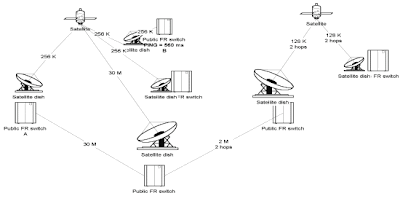
If we examine configuration below that routing to point B can be either go through totally fiber link or in case of failure the system will automatically routed the traffic through VSAT link. This will guarantee link availability and keep the service to the customer but thing we have to concern in this case that traffic from A to B will experience a delay from 100ms to 560 ms .
Even though on the VSAT side we can upgrade the link up to 2 Mbps chances that the inherit satellite will eventually cause 5 times delay.

For this back up ring solution VSAT configuration will be based on teleport type in which at the central site a 5m or a 7m antenna will be deployed while at the remote Frame Relay node a 2.4 antenna (5-10W )/single system configuration is enough as start up . Again this calculation will depend on number of Frame Relay nodes that this link have to support for any fiber link failure.
Other things we have to concern is application response time such as SNA real time application which is very sensitive to link delay. In this case customer should configure a larger time out ( T1 ) to anticipate network round trip delay due to failure in fiber link and rerouting through VSAT link.


FIG 2 RING TYPE ROUTING


RESPONSE TIME ANALISYS AND APPLICATION REQUIREMENT


PING test is performed either from GB/main node or from collocated node. Provided table of test result and refer to the diagram and pinpoint number of nodes, transmission types used in between nodes.


Figure 3 illustrated response times of fiber based Frame relay network perform in term of round trip delay imposed by network for specific application.

It clearly suggest that 20ms is the average response time packet round trip delay if number of nodes it traversed is less than three nodes. This is an ideal condition for application to perform well.

FIG-3 Response time for pure fiber network


In figure 4 further illustrated that additional nodes and less bandwidth deployed will add some delays in the network performance and eventually affect QoS.


FIG 4 Fiber network with extended nodes
The other possible configuration is ring Frame Relay network with regional HUB to accommodate traffic from Frame Relay nodes that have small number of customers.
Especially for regional with less reliable fiber backbone by terminating and distributing traffic from remote nodes will decrease the possibility of total failure compared to terminating with star configuration by using single HUB to terminate traffic.
The other aspect by routing the traffic from other satellite link will give benefit to network reliability. But delay issue emerge from this solution is exist and has to be carefully adjust to customers application timer parameters.

FIG 5 Regional HUB Frame relay

Application critical to network delay such as voice with maximum delay tolerable in an average of 125ms is not suitable if voice frames transported using frame relay with satellite link backbone. Alternative solution by adjusting customer’s router frame size is also not acceptable as well. Customers in remote areas usually start to subscribe frame relay services for data application such as on line and inter-branch application. Eventually as they find that capacity is still available on their circuit, customers ask for voice application and not realizing that traffic to it’s location actually provided by satellite.

CONCLUSION

VSAT as an alternative transmission media to interconnect Frame Relay nodes is a good solution for network expansion especially with its ability to start up in small capacity nodes . Besides that since Frame Relay technology demand low BERT link quality than a shift to VSAT is a good option even though delay which is inherit in satellite link is something that has to overcome by choosing the right application the customers can pass through the network.

Apart from that due to it’s nature of single hop than the consequences of traversing from many nodes in reaching the customers headquarters is a good nature of VSAT or satellite technology.
Further assessment of customer traffic profile will be able to find out either the traffic is symmetric or asymmetric and if that is the case than VSAT solution will be much intended due to its ability to provide asymmetric link.

With frame relay infrastructure deployed in Indonesia and with the support of satellite communication, proliferation of Internet as the way to interconnect worldwide is clearly seen. More than 80 % of dedicated Internet connection using frame relay as it’s backbone and more circuits are expected to use this infrastructure in 2000 for Internet connection due to it is available all over Indonesia and more cost effective compared digital leased line solution.
Considering Telkom-1 satellite launch success whereby it provide much better EIRP ( 3 dB increment compare to Palapa B2 R ) it will offer better link performance and therefore using satellite either as access for Frame Relay cloud network or trunk solution will bring great advantage for network reliability.

Source : The Pacific Telecommunication Council (PTC)

Read More......

The coverage map shows the downlink beam power coverage contours from the New Skies satellite NSS6 located at 95 deg east geostationary orbit longitu


This is the North East Asia spot beam. Being small in area it is technically ideal for the small dish home user or business service for anyone within the coverage area.
Look carefully at the map and consider your location.
If you are in the extreme outer contour you will need a larger dish compared with the smaller sizes required nearer the centre.
Your VSAT dish size: Inner three contours 89 cm diameter, next 1.2m, extreme outer edge 1.8m diameter.
Coverage countries include:
Bunguran, Philippines, Luzon, Mindanao, Sulu Sea, Celebes Sea, Taiwan, Hong Kong, China, Shanghai, Inner Mongolia, North Korea, South Korea, Japan, Hokkaido, Sakhalin, Manchuria, Kuril Isles
The Vipersat VSAT hub is by Global Teleports co-located at the NewSkies Mediaport at Adelaide, Australia.
http://www.satsig.net/nss6-se-asia.htm

Read More......

The coverage map shows the downlink beam power coverage contours from the New Skies satellite NSS6 located at 95 deg east geostationary orbit longitude.


This is the South East Asia spot beam. Being small in area it is technically ideal for the small dish home user or business service for anyone within the coverage area.
Look carefully at the map and consider your location. In the extreme outer contour you will need a larger dish compared with the smaller sizes required nearer the centre.
Your VSAT dish size:
Inner three contours 89cm and 1.2m, extreme outer edge 1.8m diameter. Service using the business quality dedicated 1:1 Vipersat SCPC technology.
Coverage countries include:
Hainan Island, Vietnam, Thailand, Cambodia, Kampuchea, Malaya, Malaysia, Phuket, Penang, Singapore, Aceh, Sumatra, Indonesia, Java, Borneo, Kalimantan, Celebes, Sulawest, Flores Sea. From : http://www.satsig.net/nss6-se-asia.htm

Read More......

By Prima Setiyanto Widodo
The use of the Ku-band for satellite communications in tropical regions like Indonesia seems to become more frequent. We observe that several satellites “parked” above Indonesia have Ku-band transponders, and even Ka-band transponders. Just look at the satellite owned by NewSkies (NSS 6), launched in December 2002 and positioned at 95° East, containing only Ku-band transponders and with a footprint directed to Indonesia (Sumatra, Java, Borneo, Celebes, Bali, Nusa Tenggara, Moluccas). This is also the case for the
iPSTAR satellite, to be launched this year, 2004. The Malaysia owned Measat 3, to be launched in 2005 and co-located with the Measat 1 satellite will have 24 Ku-band transponders. The Ku-band footprint directed towards Indonesia has been named by Measat the “Ku-band for Indonesia”. Measat 4 is planned to cover the whole of Indonesia from West to East. This satellite will be launched by Malaysia in the year 2007.
Why have those satellite planners the courage to use the Ku-band frequency? Of course they have calculated the technical feasibility, besides applying a regenerative system, also called Automatic Link Control, which is to exercise control over the power of the satellite to compensate for rain attenuation up to 10 db. Furthermore, for the ground segment there now exists a new development, that is the use of AUPC (automatic uplink power control) and Turbo Coding. Actually, AUPC has long been available, but it is only recently being massproduced.
With AUPC we can automatically control the transmit power in line with the rain attenuation, in general up to 9 db. With turbo coding, we can also save the power used, so that with the same transmit power we will obtain a bigger fade margin compared to a satellite modem that does not use turbo coding. At this moment, Adaptive Coding is being developed whereby the system will adapt itself to the weather conditions. The system will change the modulation in case of a weather change (rain), while retaining the bandwidth; only the throughput will decrease. By using adaptive coding, link-availability will increase.
There is an additional problem in satellite communications. TCP/IP applications have difficulties in passing through because of the long delay caused by the time it takes for the signal to travel from earth to space to earth. TCP/IP was designed for short delay times, passing through terrestrial connections. Are there solutions for this? There are, among others, by re-engineering the TCP algorithm, TCP spoofing and IP over DVB. Besides that, there is a TCP that has been designed for satellites (see www.idirect.net). This problem is not a serious hindrance any more. VPN services over satellites are no
longer just a dream; it has been proven that they can be applied successfully.
It can be imagined what could happen if these various new technologies are combined. It is time that Indonesia abandons its wariness to use Ku-band frequencies. An inexpensive system of broadband satellite services will assist greatly in the process of empowering its citizens, because for such a wide area as Indonesia, the appropriate information technology infrastructure is satellites.
One can imagine ATMs that respond quickly, and also Internet kiosks that can be moved from one site to another. The penetration of banking services can be executed faster, as well as the penetration of Internet. Distance learning and e-learning can be established relatively speedily and at lower cost. There is even the possibility to have General Elections on-line with VSATs connected to every community. This agility can only be carried out if the equipment used robust, fast and compact. We can do this with Ku-band systems.

Read More......

By Prima Setiyanto Widodo

The rain attenuation for wireless communication links can be calculated using following models:

  • ITU – R (formerly CCIR Model)
  • SAM (Simple Attenuation Model)
  • Global Crane Model
  • Model DAH (Dissanayake, Allnutt, Haidara Model)

To confirm which model is the prefered model to be used in Indonesia, field measurements should also be carried out.


Measurements of rain attenuation in Indonesia have been done for satellite communication links in Padang, Cibinong, Surabaya and Bandung. It has been found out, after due analysis, that the DAH Model for rain attenuation prediction is valid for Indonesia, besides the ITU Model. The DAH Model has become an ITU Recommendation since 2001 (Recommendation No. ITU-R P.618-7).


Based on calculations using the Rainfall Rate Prediction Model for Indonesia, the rainfall rate can be found for several locations in Indonesia. The values of the rainfall rate are then used for calculating the Rain Attenuation using the DAH Model. Thus can be calculated the “link availability” predictions for Ku-band systems in Indonesia.


The calculations by the author of this article show that the use of the Ku-band for satellite communications systems is feasible with a link availability of 99.7%. As a practical experience, based on field test results for 512 kbps data rate using a 1.8 m diameter antenna, 4 watts RF power and distance between transmitter and receiver of 180 km, demonstrated a link availability of 99.9%, confirming our previous calculations.

Read More......

The Rainfall Rate Prediction Model applicable especially for Indonesia can be developed more accurate and convincingly with the availability of field measurements as presented above. By using abovementioned data, and added to it (other) data concerning rain and thunderstorm days from the Indonesian Meteorological and Geophysical Institute, the Rainfall Rate Prediction Model for the Indonesia archipelago becomes:

R0.01 = f(Lat,Long,M,Mm) = 128.192 – 0.037Lat - 0.393Long +
0.012M + 0.017Mm
R0.01 = rainfall-rate 0.01 percent of time in a year (mm/h)
M = average rainfall a year (mm)
Mm = maximum rainfall (monthly) in 30 years
Lat = latitude
Long = longitude
This model should be used when carrying out wireless communication
link planning for wireless local loops, line of sight and satellite.

Read More......

The Rainfall Rate is one of the factors used to determine the degree of rain attenuation in the propagation of wireless communications, including satellite communications. Field measurements and recordings for long time periods are the best (empirical) method to know the rainfall rate in a country. Such data can then be used for various calculations concerning signal attenuation caused by rain.


Another way is to depend on models that have been developed by such bodies as the ITU-R Rep. 563-4 and the Global Crane model. Although both models are used to calculate rain attenuation in Indonesia, some experts consider these models not accurate enough, because there were too few samples used when developing the models.

Indonesia is fortunate that further research has been done on this matter with the idea that more accurate models can be constructed. This research has been carried out at 9 locations in the Indonesian archipelago: Jatiluhur, Cibinong, Denpasar, Padang, Surabaya, Bandung, Tanahmerah, Putusibau and Maros. Also one location is in Singapore, i.e. Bukit Timah, which is geographically located in the same position as Indonesia.

Results show that the Rainfall Rate for a 0.01% (R0.01) observation time is as follows (see table).

Table 1.1. R0.01 Rainfall Rate Measurements in Indonesia
Besides the ITU- and Global Crane model, there exist also the Rice-Holmberg and ESA/ Salonen Baptista models. From the table can be seen that there are significant differences between the results of the field measurements and the calculations using several well-known models.

Read More......

Service brings satellite bandwidth to small and medium enterprises to Southeast Asia

Singapore, June 19, 2007— IndosatM2 (IM2), one of the largest Internet and multimedia service providers in Indonesia, announced today that it will offer satellite broadband service over Ku-Band using a universal satellite hub from iDirect Technologies. The expanded service follows IM2’s success in providing satellite broadband service over C-Band and enables IM2 to offer satellite broadband to thousands of small and medium enterprises throughout Southeast Asia in remote and unreachable locations, as well as to the consumer market. iDirect Technologies (iDirect) is a global provider of satellite-based broadband communications solutions and a company of VT Systems Inc.

Through iDirect’s 5IF iNFINITI satellite hub, IM2 can deliver satellite broadband over Ku-Band, providing maximized bandwidth efficiency while maintaining data integrity in remote locations and tropical weather conditions. The new service provides enterprise-class backhaul communications for voice, data and video. IM2 is showcasing its satellite broadband service at CommunicAsia 2007 in Singapore, featuring a live videoconferencing demonstration at the iDirect exhibition booth #6K1-07 during exhibition hours.

“Offering broadband satellite technology enables IM2 to satisfy growing communications demands from businesses in rural and unreachable locations. IM2, one of the major Internet and multimedia service providers in Indonesia, intends to deliver broadband services to small and medium enterprises and the consumer market in Indonesia. IM2 will provide Internet and VPN services using iDirect’s VSAT over Ku-band solution, which expands the range of services that IM2 is providing to its customers.”

~ Indar ATMANTO
President Director, IM2

The iDirect satellite communications platform delivers the most cost-effective bandwidth allocation with an approximate 98 percent payload efficiency. iDirect’s “Deterministic-TDMA” allocates bandwidth among multiple remote sites based on instantaneous conditions, enabling service providers to carry more traffic. iDirect hubs can configure networks starting at 64 Kbps and scale up to 18 Mbps in 1 Kbps increments. Service providers can manage all connections from a central location through iDirect’s Network Management System (NMS).

“IM2 is extending the power of broadband communications throughout Southeast Asia and providing businesses with every option they need to stay connected. With iDirect’s universal satellite platform, service providers like IM2 can lower their operating expenses, while offering customers greater network functionality.”

~ Andrew BOND-WEBSTER
Regional Vice President and Managing Director, Asia, iDirect

IM2’s broadband satellite services span Singapore, Kuala Lumpur, Manila, Vietnam, Bangkok, Phnom Penh and West Indonesia, including Bali.

Please visit us at CommunicAsia 2007 from 19 to 22 June to see our latest solutions.
Singapore Expo, Hall 6, Booth 6K1-07 – iDirect booth showcases iDirect COTM solutions including IM2’s new satellite broadband service and diverse bandwidth delivery models through iDirect New Group QoS functionality.

*****

iDirect Technologies, a subsidiary of VT Systems Inc, designs, develops, and markets satellite-based broadband access solutions targeted at the enterprise, government, carrier and educational sectors that have the need for fast, flexible, and geographically dispersed two-way internet/intranet access. The company has developed technology solutions that combine high performance, worldwide availability, ease of installation, high reliability, and low cost to end customers. In addition, iDirect solutions offer unprecedented efficiencies, increased revenue opportunities and higher per customer gross margins to satellite network operators. iDirect was awarded the 2005 World Teleport Association Teleport Technology of the year, the Innovation & Technology of the Year by The ISCe Advisory Board, and named number one in the Deloitte & Touche Virginia Technology Fast 50 list of the fastest-growing U.S. technology companies. iDirect operates its corporate headquarters in Herndon, Virginia and has regional offices in Europe, Asia, and covering Latin America. Additional information is available on the company website at www.idirect.net.

VT Systems Inc and its subsidiaries are preferred providers of engineering solutions, products, integrated systems, and services in the Americas across the core business areas of marine, aerospace, electronics and land systems. Headquartered in Alexandria, Virginia, VT Systems operates throughout North America and offers a broad range of proven innovative services to both the commercial and government sectors. VT Systems is a wholly owned subsidiary of Singapore Technologies Engineering Ltd.
Please visit www.vt-systems.com.

About IM2
PT Indosat Mega Media (IM2) was operated in 2000 as a subsidiary of PT Indosat Tbk, the leading telecommunication service provider in Indonesia. IM2 provides Internet, private network and also offers web hosting, collocation, and pay TV services. At present IM2 operates one of the most extensive network infrastructures in Indonesia, including the largest capacity bandwidth thru submarine fiber optics connections to access international backbones.

Media Contacts:
John Severance
Sheffield Marketing Partners for iDirect
Phone: 630-281-4097
Mobile : 312-953-3396
E-Mail: jseverance@sheffieldcompany.com

Julie Gouldin
Vice President Corporate Marketing
iDirect Technologies
Phone:703-648-8155
E-Mail: jgouldin@idirect.net

Carol Hrovoski
Corporate Communications Manager
VT Systems
Phone: 703-739-2610
E-Mail: chrovoski@vt-systems.com

Pak Hermanudin
Business and Product Development Manager
IndosatM2 (IM2)
Phone: 62-21-7854-6969 ext. 221
E-Mail: Hermanudin@indosatm2.com

Source: http://www.idirect.net

Read More......

Followers

TS2 Satellite Technologies

Broadband Systems

VSAT Networks